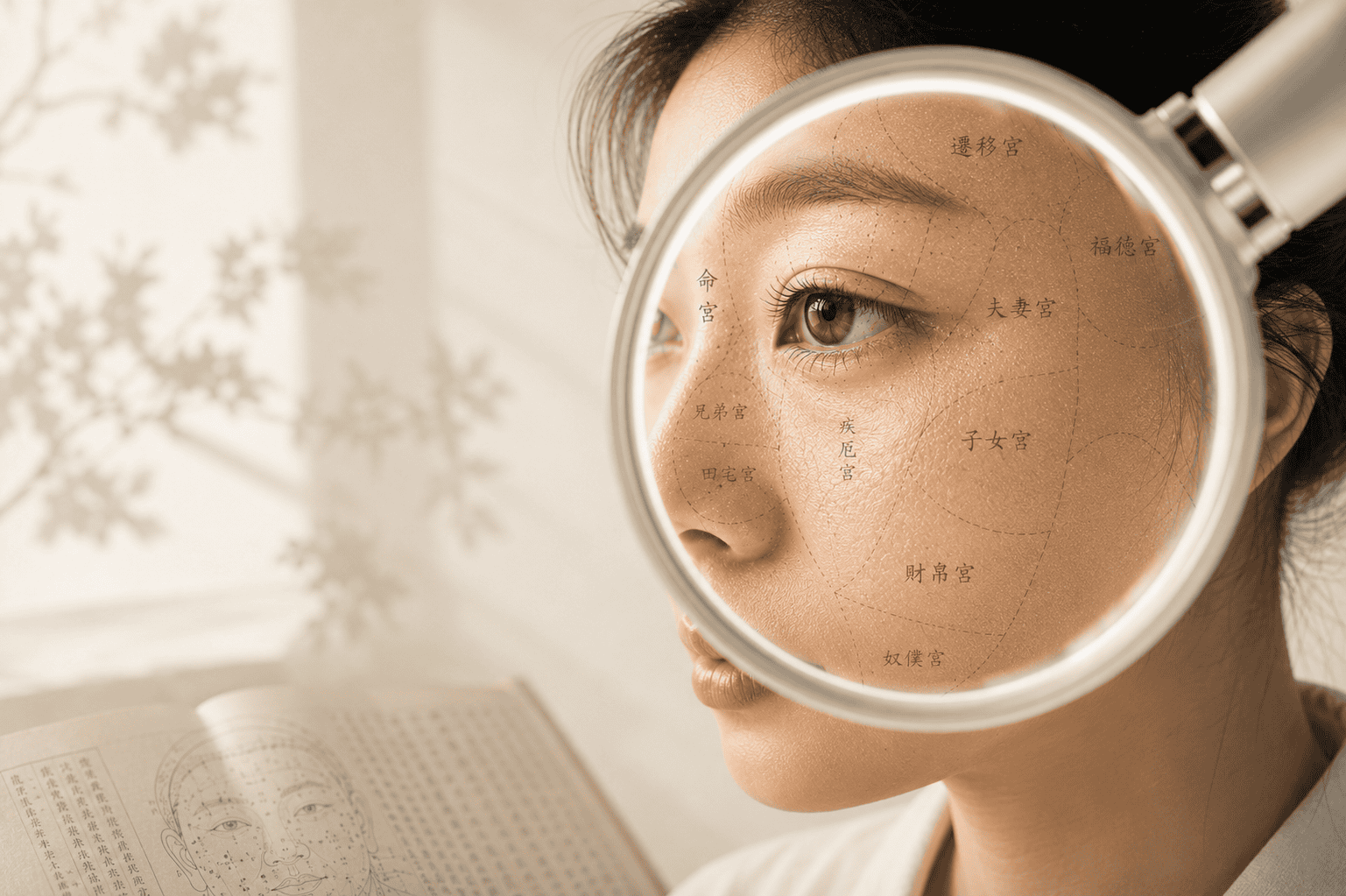
What your face reveals
Chinese medicine’s diagnostic map and what current research is finding
Every patient who walks through the door tells me something before they say a word.
The way someone moves. Whether they hold tension in their jaw or their shoulders. Whether their eyes are bright or flat. Whether their color is vivid or dull. This kind of observation is part of good clinical practice in any tradition. In Chinese medicine, it is systematized. The face in particular has been understood for thousands of years as a map of internal health, a surface where the state of your organs, your circulation, your constitutional strength, and your emotional history all leave visible traces.
That system has a name: mien shiang, translated as face reading.
I use it in every session. It is one part of a diagnostic conversation that also includes pulse, tongue, and everything a patient tells me in their own words. No single element tells the whole story. Together, they build a picture that guides treatment.
Where this comes from.
Mien shiang has roots in the same classical period as acupuncture itself. The Huangdi Neijing describes the face as a reflection of the five organ systems: the heart, liver, spleen, lungs, and kidneys. Each system governs not just a physical organ but a set of functions, tissues, and emotional tendencies, and each leaves its marks in a specific region of the face.
Practitioners added to it across centuries of clinical observation. What emerged is a detailed framework for reading color, texture, markings, and structure as indicators of what is happening internally.
This is not physiognomy in the fortune-telling sense, though mien shiang has been used that way in Chinese culture as well. In clinical practice, it is one diagnostic input among several, used to notice patterns and refine a treatment plan.
What I am actually looking at.
The face is read in several ways simultaneously. Color is the most immediate. Structure and proportion come next. Then markings: lines, spots, areas of puffiness or hollowness, discoloration.
The three zones correspond to different systems. The upper zone, from hairline to brow, connects to the bladder and small intestine and reflects the nervous system. Persistent horizontal creases across the forehead often accompany chronic worry or digestive strain. The middle zone, from brow to the base of the nose, corresponds to the liver, gallbladder, and the body’s capacity for smooth flow. A deep vertical crease between the brows is one of the more reliable indicators of long-term liver tension. The lower zone, from nose to chin, connects to the stomach, kidneys, and reproductive system.
Each facial feature carries its own information. The nose connects to the stomach and spleen. The ears to kidney function and constitutional depth. The area directly under the eyes reflects the state of the kidneys and fluid metabolism. Puffiness there often signals fluid stagnation. Darkness or hollowness points toward depletion.
The lips and mouth correspond to the digestive system broadly. Pale, dry lips suggest blood or fluid deficiency. Cracking at the corners often points to stomach heat. The chin and jaw connect to the kidneys and reproductive system, which is why hormonal disruption so frequently shows up in the lower third of the face.
Color is where the five elements map most directly.
Each of the five elements has a corresponding color that, when it appears in excess or in the wrong location, indicates an imbalance in the associated system.
A reddish cast, particularly across the cheeks or the tip of the nose, connects to the fire element and the heart system. It can indicate heat: inflammation, cardiovascular stress, or chronic emotional agitation. A yellowish tinge to the skin connects to the earth element and the digestive system, often pointing to dampness or sluggish function in the stomach and spleen. This is not jaundice, which is a distinct medical presentation, but a subtler coloration visible in the overall tone.
A pale or whitish complexion connects to the metal element and the lungs. It often accompanies grief, chronic respiratory issues, or significant qi deficiency. A bluish or purplish quality, particularly around the lips or beneath the eyes, connects to the water element and the kidneys, and frequently indicates cold, poor circulation, or deep depletion. A greenish cast, especially around the mouth or at the temples, connects to the wood element and the liver, often appearing with significant stress patterns or blood deficiency.
The healthy baseline is what Chinese medicine calls a lustrous complexion: whatever the person’s natural skin tone, there is a quality of brightness and moisture to it that reflects good circulation and sufficient vitality. Dullness or a lack of luster is often the first sign that something is shifting, before symptoms become pronounced enough to name.
How this changes what happens in the room.
What I am doing when I look at a patient’s face is not running through a checklist. It is pattern recognition, something that sharpens over years and becomes increasingly reliable.
A face tells me whether we are dealing with depletion or congestion, heat or cold. A patient who comes in for chronic joint pain and whose face shows a pale, slightly dull complexion with hollowness under the eyes is telling me something different than a patient with the same complaint whose face is ruddy and whose brow is deeply furrowed. The first points toward depletion and cold. The second toward stagnation and heat. The treatment for each is different, even if the symptom they walked in with is identical.
This is what pattern differentiation means in practice. The symptom is where we start. The pattern is what we treat. Facial reading is one of the tools that helps clarify the pattern.
It also works in the other direction. Changes in the face over a course of treatment are one of the ways I track progress. When a patient whose complexion was dull starts to show more luster, when the hollowness under the eyes begins to fill in, when a deep crease between the brows begins to soften, these are signs that the underlying pattern is shifting. They often come before the patient has words for what has changed. The face moves first.
What current research is finding.
Clinical studies specifically validating mien shiang are sparse. That remains true. But the broader research landscape has shifted considerably, and it points in a direction that practitioners of Chinese medicine will find familiar.
A 2024 systematic review and meta-analysis published in the Postgraduate Medical Journal examined 22 studies covering more than 57,000 cases and found that deep learning facial recognition for disease diagnosis achieved 91% accuracy. The research came out of Shandong University of Traditional Chinese Medicine and was grounded explicitly in TCM inspection principles. Researchers are building AI diagnostic systems on the premise that the face carries measurable, reliable signals about internal health state. That is the same premise mien shiang has operated on for three thousand years.
A 2023 study published in Computers in Biology and Medicine demonstrated that facial skin images alone could simultaneously identify diabetes, fatty liver disease, and cancer-related fatigue in patients, framing the methodology directly in TCM inspection theory. The researchers noted that disharmony in qi, blood, or internal organs is reflected in facial complexion, and that this observation provides clinically valuable, non-invasive diagnostic information.
A 2022 study from Beijing University of Chinese Medicine used objective facial and tongue features to develop and validate a diagnostic tool for identifying blood stasis constitution. The facial markers it identified, including lip color, zygomatic vascular patterns, and pigmentation changes, are consistent with what practitioners have been reading clinically for centuries.
A 2024 review published in Frontiers in Medicine noted that researchers have successfully developed deep learning methods for detecting coronary artery disease from facial photographs, with a sensitivity of 80%. The approach explicitly draws on the TCM observation that facial color and features reflect the state of the cardiovascular system.
None of this proves mien shiang point-for-point. The research is not designed to do that. What it demonstrates is that the foundational claim, that the face carries measurable, clinically meaningful information about internal health, is not only ancient observation but an active area of scientific investigation producing real results. The language is different. The instruments are different. The core observation is the same.
What this means when you come in.
Mien shiang is not something I explain during a visit. It happens in the background, part of the continuous observation that runs throughout a session. What a patient sees is that I am paying attention. What I am actually doing is reading.
The face is one part of the picture. It confirms what the pulse suggests, sharpens what the tongue indicates, gives context to what you tell me. Nothing in isolation. Everything together.
If you are curious about what your face might be revealing, that conversation can happen in the room.
Your first visit is where we look at the whole picture together.
Sharon Sherman, MSOM, Dipl. AHM (NCBAHM), L.Ac., has practiced acupuncture and East Asian Medicine full time since 2001, and at True to Life Wellness in Freeport, Maine since 2025.
Last reviewed: May 2026
This page is for educational purposes and does not constitute medical advice.