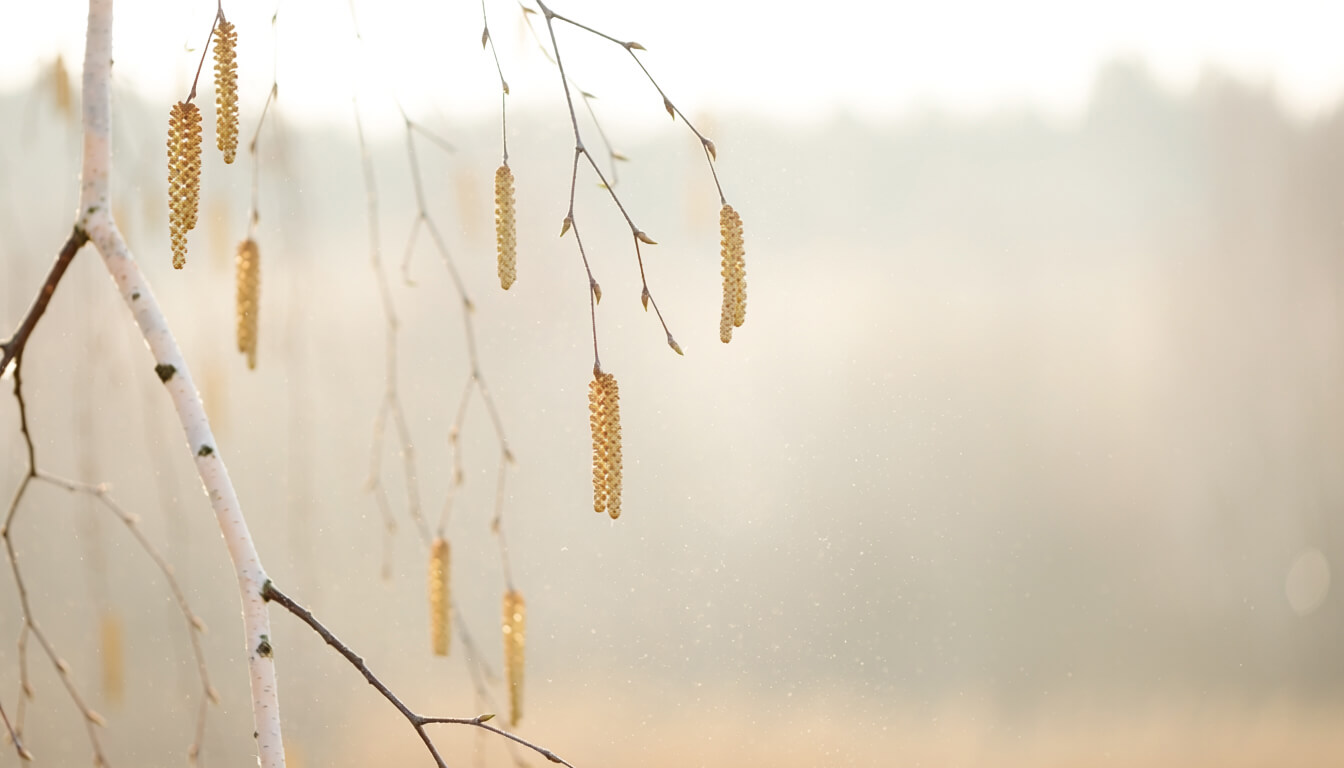
You’re not imagining it. Spring is getting harder.
Why seasonal allergies seem to worsen every year, and what acupuncture can do about it
The sneezing starts before most people are ready for it. In Freeport, the first wave usually arrives in late February or early March, when juniper and poplar begin releasing pollen before the season has even registered. By April, maple, birch, and oak have joined in. That is when a good number of patients walk in with the same look: tired eyes, congested, a little depleted by something that happens every year and somehow still catches them off guard.
Some have been managing with antihistamines for years. The medication takes the edge off. It does not resolve the underlying pattern. And every spring seems a little worse than the last. That is not imagination. Pollen seasons are lengthening, and for people whose immune systems are already reactive, the cumulative burden adds up.
What most have not tried is treating the reactivity itself, rather than the reaction.
What’s actually happening
The body isn’t overreacting to pollen. It’s lost its footing.
Seasonal allergic rhinitis affects somewhere between 10 and 30 percent of adults, according to the American College of Allergy, Asthma and Immunology. The conventional explanation is immune hypersensitivity: the body mistakes harmless environmental particles for threats and mounts a histamine response that produces the familiar cascade of sneezing, congestion, itchy eyes, and fatigue.
Chinese medicine adds a different question to that picture: why does this person’s body respond this way when others do not? The answer, in most cases, is a deficiency at the body’s defensive surface, what Chinese medicine calls Wei Qi. Wei Qi circulates just beneath the skin and in the mucous membranes. Its job is to regulate the boundary between body and environment. When it is strong, seasonal change is handled without incident. When it is depleted, the body overreacts to what it encounters. It is the same underlying logic that shapes how I approach every patient.
This is why I ask about sleep, digestion, energy, stress, and season when someone comes in for spring allergies. The nasal symptoms are visible. The depletion that makes the body vulnerable to them runs deeper and longer.
What the research shows
Acupuncture addresses the allergic response at a systemic level.
A 2024 review in the International Journal of General Medicine examined acupuncture’s mechanisms in allergic rhinitis. It found that acupuncture reduced histamine and IgE levels more significantly than standard drug therapy alone, and improved quality of life across six trials involving 1,209 participants. Adverse events were low, and less frequent than those associated with conventional drug therapy.
A 2022 systematic review in European Journal of Medical Research synthesized thirty trials and 4,413 participants. High-quality trials showed acupuncture comparing favorably to antihistamines in head-to-head studies. The evidence base is substantive.
What stands out is the mechanism. Acupuncture appears to modulate immune response systemically, not just suppress local symptoms. Reducing histamine at the surface is not the same as changing the conditions that keep triggering it. Antihistamines do the first. Acupuncture, over a course of treatment, works toward the second.
The timing question most people don’t ask
Starting before the season begins changes what’s possible.
Spring allergies can be treated year-round, but patients who do best almost always start in late winter. February and early March, before the pollen count climbs and the immune system is already reactive, is when the body is most receptive to building what it needs for the season ahead.
This is one of the principles embedded in classical Chinese medicine texts: address the body before disease manifests, in the season that precedes the problem. For allergic rhinitis, that means supporting lung and spleen qi in winter, strengthening Wei Qi at the surface, and giving the body a foundation to stand on when spring arrives.
In coastal Maine, the pollen calendar runs longer than most people realize. Tree pollen begins in late February and runs through May. Grass pollen follows in late May and June. By August, ragweed and weed pollens take over and run through October, a pattern tracked by the National Allergy Bureau. For patients who feel symptomatic most of the year, they may well be. Each wave activates an immune system that never fully settled from the last one.
For patients who come in mid-season, the approach shifts. The work becomes managing the acute response, calming the reactivity, and providing enough support to get through the weeks ahead. For anyone in Freeport reading this in March or early April: that window is still open.
What herbal medicine adds
Some of the most useful tools are not needles.
Chinese herbal medicine works alongside acupuncture for seasonal allergies, and for some patients it provides the continuity between sessions that makes results hold. One formula frequently useful during allergy season is Bi Yan Pian, which translates roughly as “nose inflammation tablet.” It addresses both wind-cold and wind-heat presentations, the two most common patterns underlying allergic rhinitis, without requiring a precise differentiation at the outset. That kind of pattern differentiation shapes every treatment decision I make.
For patients in the building phase, before the season fully arrives or between acute flares, Yu Ping Feng San serves a different purpose. This three-herb formula, whose name translates as “jade windscreen,” strengthens Wei Qi at the surface and reduces underlying susceptibility to seasonal triggers. A meta-analysis published in BMC Complementary Medicine reviewed seven databases and found that Yu Ping Feng San used alongside conventional therapy produced meaningful benefit when administered for more than three weeks, with immune-modulatory effects including reduced inflammatory cytokines. Where Bi Yan Pian addresses what is happening now, Yu Ping Feng San works on why it keeps happening.
I assess and adjust at every visit. The formula right for someone in the first week of acute symptoms is often not the right formula two weeks later, when the work shifts to consolidation and prevention.
What patients tell me
The change that surprises them most is the one they weren’t tracking
Patients who come in for spring allergies often report, after a few sessions, that their sleep has improved, their afternoon energy is steadier, or that the low-grade headaches and anxiety they carry eased around the same time the sneezing settled down. This is not coincidence. The systems that drive allergic reactivity are the same systems that govern sleep, energy, and stress response.
When the underlying deficiency is addressed and the body’s surface function is restored, the effects extend beyond the sinuses. Patients who have been managing symptoms for years without ever feeling like the problem is really improving often find this is the approach that changes the picture, for reasons I explore in How Will You Know It Is Working.