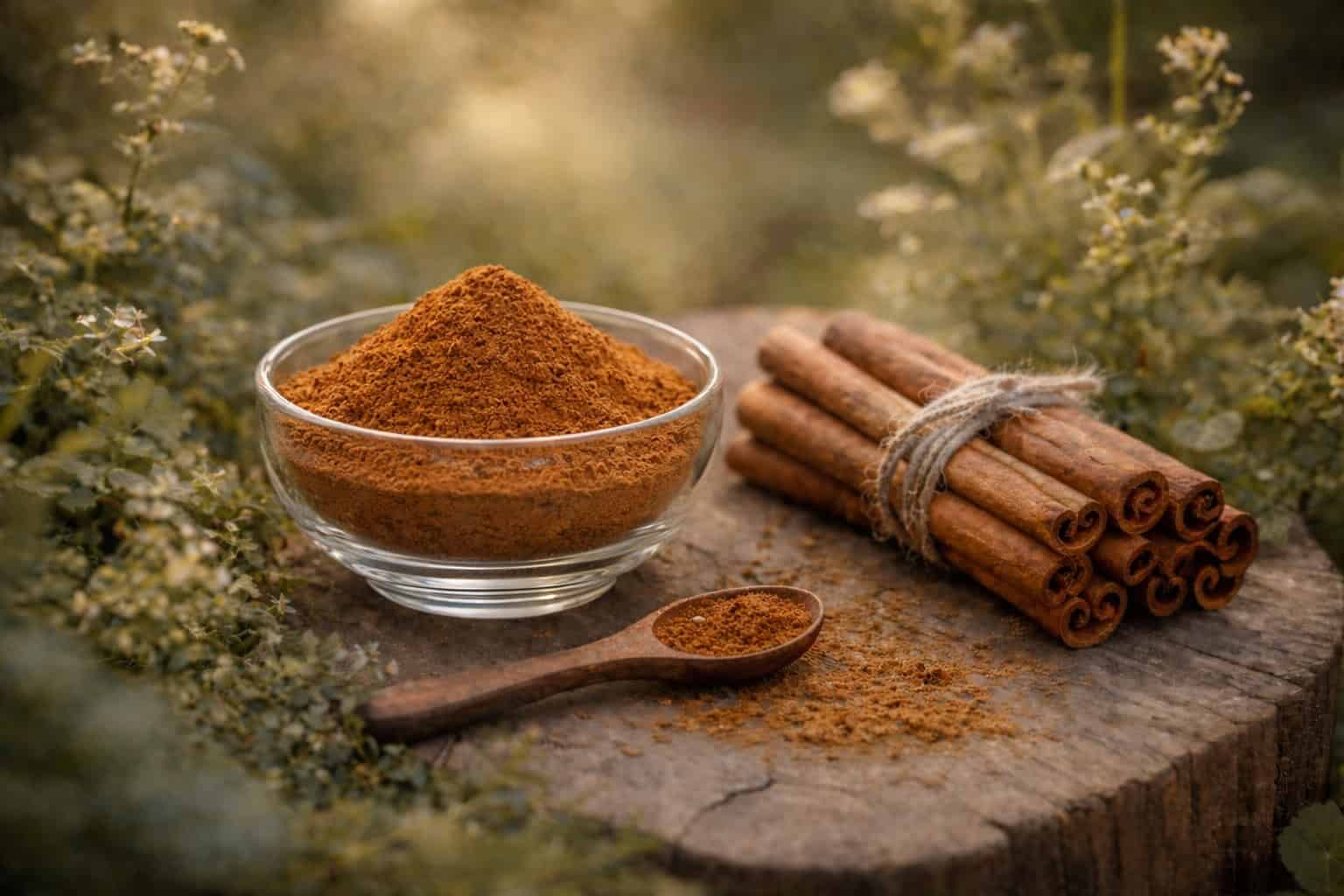
What Chinese medicine knows about cinnamon — and science is confirming
Gui Zhi, Rou Gui, and two thousand years of cinnamon as medicine
There’s a good chance you have it in your kitchen right now. Tucked in the back of a cabinet, used for oatmeal, maybe dusted over a holiday drink and forgotten until next year. Cinnamon is so familiar it barely registers as medicine. But it has been, for a very long time, and for reasons that modern research is beginning to map in useful detail.
If you’ve ever wondered what Chinese herbal medicine actually looks like in practice, cinnamon is a good place to start. It’s something most people already have some relationship with, and the way we use it in East Asian medicine says a lot about how this whole system thinks.
Two herbs, one tree
The twig and the bark are not interchangeable.
In Chinese herbal medicine, we work with two distinct parts of the cinnamon tree. They share a lineage but behave quite differently in the body, and choosing between them is a good example of the kind of precision that makes herbal medicine more than just “natural remedies.”
Gui Zhi is the cinnamon twig, the young, thin branches of Cinnamomum cassia. Spicy, sweet, and warming in nature, it works primarily at the surface of the body. I reach for Gui Zhi when someone is fighting off the early stages of a cold, when circulation to the hands and feet is sluggish, or when cold has settled into the joints and muscles. It moves outward and upward, encourages the body’s defensive energy to engage, and helps shift what’s stuck.
Rou Gui is the inner bark: denser, hotter, and slower. Where Gui Zhi works at the surface, Rou Gui reaches deeper. It’s suited to chronic cold conditions, the kind rooted in what Chinese medicine calls kidney yang deficiency: persistent low back weakness, cold that never quite lifts, fatigue that doesn’t respond to rest. This herb warms from the interior out.
The distinction matters. Someone coming in with aching joints and cold hands after a hard winter needs a different approach than someone who has spent years running depleted. Same plant, two medicines, two very different conversations.
What Chinese medicine has always understood
Cinnamon has been in clinical use for over two thousand years.
The Shang Han Lun, one of the foundational classical texts of Chinese herbal medicine, opens with Gui Zhi Tang, a five-herb formula built around the cinnamon twig. This was not arbitrary. The authors were working from careful, accumulated observation: that cinnamon reliably moved circulation, expelled cold, and helped the body find its balance between its surface defenses and its deeper reserves.
That’s a concept that doesn’t translate neatly into Western physiology. But the clinical applications it pointed toward are ones that modern research is now examining, and the findings are interesting.
What the research shows
The science is catching up with the tradition.
If you’re someone who likes to know there’s research behind what you’re taking, cinnamon delivers. A 2024 review in Frontiers in Pharmacology examined cinnamaldehyde, the primary active compound in Cinnamomum cassia, and documented cardioprotective properties including enhanced blood supply to the heart muscle, reduced clot formation, and improved coronary artery blood flow, along with anti-inflammatory and antioxidant effects consistent with its traditional uses.
A 2023 umbrella meta-analysis in Nutrition, Metabolism and Cardiovascular Diseases synthesized existing meta-analyses on cinnamon’s effects across lipid profile, oxidative stress, and inflammation markers in adults. The findings supported benefits for triglycerides and markers of cardiometabolic health, and highlighted that effects vary by dose and form, which aligns with how we use the herb clinically: the amount and preparation both matter.
Earlier research in Evidence-Based Complementary and Alternative Medicine identified the mechanism behind cinnamon’s anti-inflammatory activity more specifically: cinnamaldehyde inhibits iNOS, COX-2, and NF-κB, the same inflammatory signaling pathways targeted by many pharmaceutical anti-inflammatory drugs. The same study characterized Cinnamomum cassia as one of the fifty fundamental herbs in traditional Chinese medicine, with documented use for digestive conditions, circulation disturbances, and inflammatory disease.
None of this surprises me. But it’s useful confirmation, and it raises a question worth sitting with: if a common kitchen spice has this much going on pharmacologically, it suggests the tradition it comes from is worth taking seriously.
Why a spice isn’t the same as a medicine
Context, combination, and dose are everything.
You might be wondering: should I just add more cinnamon to my diet? It’s a fair question. The short answer is that culinary amounts are lovely, and there’s nothing wrong with them, but they’re a different thing than therapeutic use.
In practice, Gui Zhi rarely works alone. Gui Zhi Tang pairs the cinnamon twig with peony root, ginger, jujube, and licorice: each herb modifying and focusing the action of the others. Gui Zhi Fu Ling Wan, one of the most commonly used formulas in gynecology, combines the twig with poria, tree peony bark, peach kernel, and red peony root to address blood stagnation and reproductive irregularity. The cinnamon isn’t incidental to these formulas. It’s structural. But what it does depends entirely on what it’s paired with, what pattern it’s addressing, and who is receiving it.
Western research typically isolates one compound and measures one outcome. That’s how clinical trials work, and the findings are genuinely useful. But it’s a different frame than Chinese herbal medicine, where the goal is a formula tailored to your specific pattern, not a compound matched to a diagnosis.
What this looks like when you come in
Cinnamon appears in some of the most commonly used formulas in Chinese medicine.
I reach for Gui Zhi most often when someone presents with sluggish circulation, cold hands and feet, early-stage immune vulnerability, or musculoskeletal pain that worsens with cold and improves with warmth. It’s also a key herb in formulas I use for menstrual irregularity, particularly when there’s cold stagnation in the lower abdomen.
Rou Gui I use more selectively, for patients whose patterns reflect deeper, chronic depletion, where the warmth needs to reach further and hold. It’s a slower, steadier medicine.
In both cases, what I’m tracking isn’t a single biomarker. I’m reading a pattern: how you hold heat, how you recover, what time of year your symptoms worsen, what the quality of your pulse says about the state of your circulation and reserves. Cinnamon, in either form, is one tool in that conversation.
The research on cinnamaldehyde and cardiovascular function, on anti-inflammatory pathways, on blood sugar regulation, is building a partial picture of why that conversation has been productive for two thousand years. I find it genuinely interesting. And it confirms something worth saying plainly: the herb in your spice cabinet is doing more than adding flavor.
If you’re curious whether herbal medicine might be useful for what you’re dealing with, your first visit is where that conversation begins.
Sharon Sherman, MSOM, Dipl. AHM (NCBAHM), L.OM., L.Ac., practiced acupuncture and East Asian Medicine in Philadelphia for over two decades before founding True to Life Wellness in Freeport, Maine in 2025.