One herb rarely works alone
Ask someone what an herbalist does and they’ll often picture a jar of something. One root, one flower, one remedy for one complaint. Turmeric for inflammation. Ginger for nausea. Take the thing, get the effect.
That’s not how Chinese herbal medicine works. In twenty-five years of practice, I can count on one hand the times I’ve sent a patient home with a single herb. Almost everything I prescribe is a formula, a combination of herbs chosen and dosed to work as a group. This isn’t an accident of tradition. It’s the whole design.
Older than you’d think
Chinese herbal medicine traces back to Shennong, a legendary farmer-teacher said to have personally tasted and recorded the effects of hundreds of individual herbs. That work was eventually compiled into the Shen Nong Ben Cao. But that text catalogs herbs one at a time. The shift to combining them into deliberate formulas is credited to Zhang Zhongjing, a physician working not long after, whose Shang Han Lun, the Treatise on Cold Damage, laid out formulas still prescribed today largely unchanged. What he built was a systematic way of matching a combination of herbs to what the Shang Han Lun calls a specific pattern of disharmony, a collection of symptoms that, taken together, point to a particular disease state, rather than a single herb to a single symptom.
Both texts trace to the Han dynasty, 206 BCE to 220 CE. That’s not a coincidence. It was an especially prolific stretch for Chinese herbal medicine, the period where centuries of scattered, orally transmitted herb knowledge got organized into the systematic texts that still anchor the field today. A formula built well doesn’t just add herbs together. It sends the body a very specific, sophisticated message, one a single ingredient isn’t built to carry alone.
Combinations, on purpose
Western pharmacology tends to isolate. Find the active compound, strip away everything else, standardize the dose. Chinese herbal medicine takes the opposite approach. It layers multiple herbs together on purpose, because the interaction between them is often where the therapeutic value lives.
This isn’t hand-waving. Before a formula is even swallowed, certain herb pairs, dui yao, herbs chosen to work as a unit, form entirely new compounds during the boiling process itself, structures neither herb produces alone. Cinnamon twig and white peony are a classic pair like this, showing up together again and again for what they do as a unit, not separately. Once a formula is in the body, one herb can carry another somewhere it couldn’t reach by itself. Once it lands, they can converge on the same problem from different angles, or split the work between them.
That convergence isn’t only about mechanism. It’s also about place and direction, and the herbs don’t always move the same way. Sometimes a group moves together, aimed at the same place, from the same direction. Just as often, one herb is chosen specifically to hold another back. Cinnamon twig rises and pushes outward. White peony does the opposite, holding the line so cinnamon doesn’t overshoot and sweat out more than the body can spare. Both belong in the same formula on purpose.
Researchers have a name for this: synergy. Not that the herbs are combined, but that the combination does more than they’d add up to alone, often while the gentler herbs blunt what the harsher ones would do left on their own. Licorice root shows up in an outsized number of classical formulas for exactly this reason. Not the star of the show. The one keeping everything else honest.
Four roles, not a random mix
Formulas aren’t built by grabbing herbs that sound helpful and hoping for the best. They’re built around four roles, sometimes called Jun-Chen-Zuo-Shi, or in English, Chief, Deputy, Assistant, and Envoy. Each one has a job, and some have more than one.
The chief does the main work, the herb aimed most directly at the problem, the one a formula can’t do without. The deputy backs up the chief, or takes on a second problem the chief doesn’t touch, since a formula often has more than one thing going on. The assistant is the most flexible role. Sometimes it reinforces what the chief and deputy are already doing. Sometimes it tempers them, softening a harsh herb so it doesn’t cause a problem of its own. And sometimes, less intuitively, it works in the opposite direction of the chief entirely, a deliberate counterweight, for when a condition is complicated enough that pushing one way isn’t safe without something holding the other. The envoy either points the formula toward a specific part of the body, or ties the other herbs together so they act as one effort instead of several.
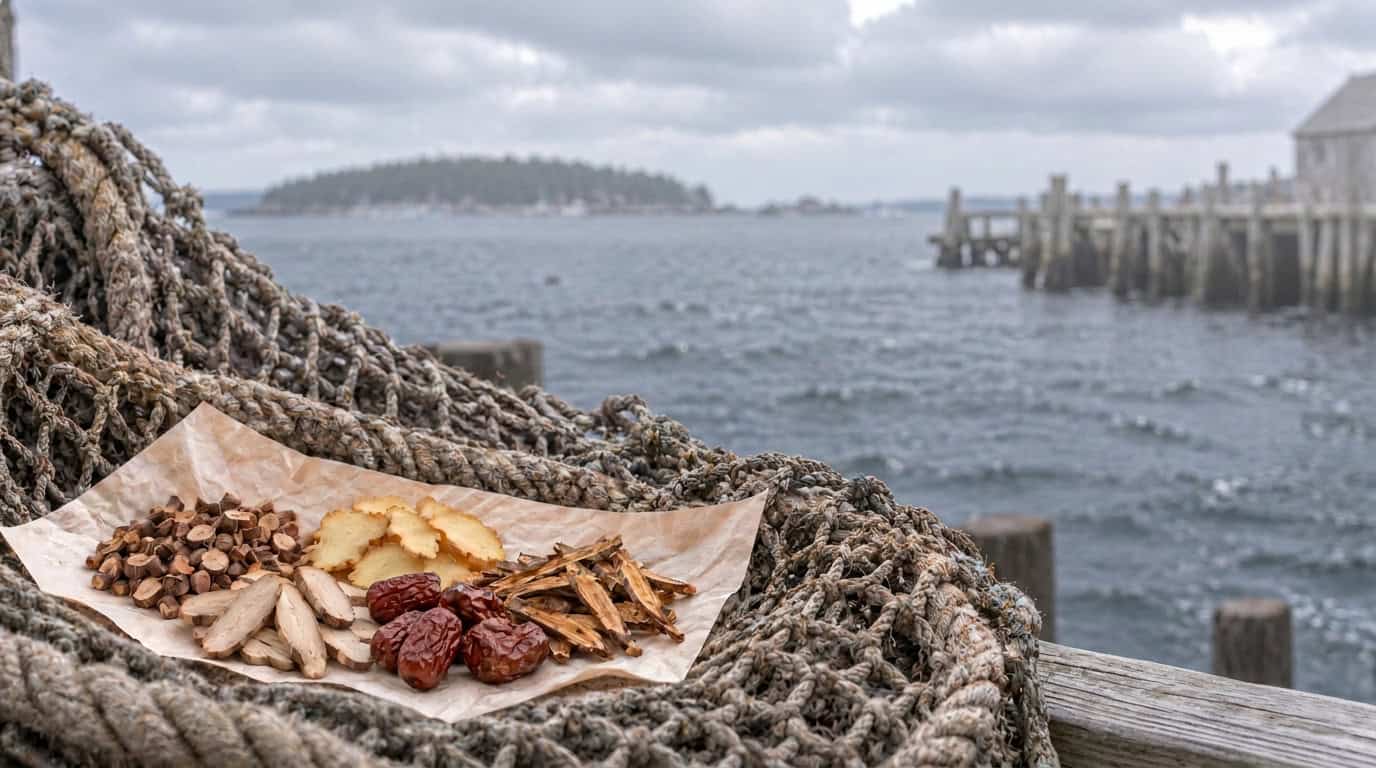
Take Gui Zhi Tang, Cinnamon Twig Decoction, the very first formula in Zhang Zhongjing’s Shang Han Lun and still one of the most commonly used formulas for the early stage of a cold today. Cinnamon twig gently warms the body and opens things up enough to sweat out what’s settling in. That’s the chief. On its own, that’s a problem: too much sweating and you lose fluid you need. So white peony, the deputy, rides along holding the line, that same opposite-direction pairing from a moment ago, keeping the cinnamon from overshooting. Ginger and jujube date settle the stomach and keep the body fueled enough to actually mount a response, since fighting off a cold takes energy. And licorice root, the envoy, ties the whole thing together so it acts as one coordinated effort instead of four separate actions working past each other. Five plants, each solving a problem the others create or can’t solve alone.
This is why swapping one ingredient in a classical formula isn’t a minor tweak. Change the lead herb and you’ve changed what the formula is for. Remove the one managing side effects and you may lose the thing keeping a strong herb from being too strong. A formula is closer to a piece of architecture than a list of ingredients. Each part is load-bearing.
Built from more than the chief complaint
None of this starts with the formula. It starts with an intake that goes well beyond the symptom that brought someone in the door. A thorough herbal consultation asks about sleep, digestion, stress, appetite, temperature preferences, even what brings a person enjoyment. Questions that can feel unrelated to, say, a knee that won’t stop aching. They aren’t unrelated. They’re how a practitioner maps the whole terrain, the same way reading a face or reading a pulse maps it, body and mind together, so the formula that gets built matches the person, not just the complaint.
It’s also why a formula can, and often should, change over time. As a patient’s pattern shifts, as the underlying imbalance resolves or a new symptom becomes more prominent, the formula gets modified alongside it. A prescription is meant to track the person, not sit still.
The many forms a formula can take
The same formula can be prepared more than one way, and the form isn’t incidental. It’s a clinical choice, made the same way the herbs themselves are chosen.
A decoction, herbs boiled in water and drunk as tea, is the oldest form and the most responsive. It acts fast and can be adjusted dose by dose, which is why I reach for it with anything acute or still finding its shape. It also takes time to prepare, doesn’t keep, and asks something of the person drinking it.
A pattern that’s settled into something chronic doesn’t need that kind of responsiveness. It needs staying power. That’s where pills earn their place: slower to act, but built to hold a formula’s effect over weeks instead of days, and better suited to potent or aromatic herbs that don’t take well to boiling. Plasters and syrups do their work externally, or as long, slow tonifying support. Granules are the newest form, a formula taken through extraction and drying, so it can be stirred into water on the spot. What’s traded away is some of the decoction’s complexity. What’s gained is that it actually gets taken.
None of this is universal. The right form depends on the pattern, the stage of treatment, and what a person’s life can actually hold, which is why it’s a conversation, not a label on a bottle.
It won’t look like your prescription bottle
Most people come in expecting something that behaves like a pharmaceutical. One pill, once a day, same dose every time. Chinese herbal medicine doesn’t work on that schedule, and it’s worth saying up front so it doesn’t come as a surprise.
The typical dose for a formula runs 3 to 9 grams per dose, taken three times a day, sometimes more for a decoction. A decoction means real volume: you’re drinking a cup of liquid each time, not swallowing a capsule. The goal is to keep a steady level of the formula active in the body, not a single spike that wears off by evening. That’s a bigger ask than a once-a-day prescription, and I say so plainly before anyone starts, because a formula only works if it actually gets taken the way it’s meant to be taken.
Why this matters if you’re the one taking it
If you take away one thing from this, let it be this: I’ve had patients walk in with a full shopping bag of supplements. One for gut health, one for joints, one for sleep, one for immune support, each one purchased to guard a separate system. That’s a reasonable instinct, but it’s the opposite of how a formula works. A well-built formula isn’t a bundle of separate remedies stacked for extra strength. It’s closer to an ensemble. One herb doing less on its own so that, in combination, the whole group can do more, more safely, than any one of them could manage alone.
That’s also why the choice between a patent formula and a custom-compounded one is a real clinical decision, not just a matter of convenience. A well-made patent formula is a fixed version of a classical combination: reliable, well-tested, and often exactly right for a pattern that matches the textbook case closely enough. I dispense plenty of them. But when a pattern doesn’t quite fit the mold, or shifts as treatment progresses, that’s where a custom formula earns its place. The chief herb, the dose of the assistant moderating a side effect, the form the formula is prepared in: these can all be adjusted for the person in front of me, in a way a fixed formula can’t be. It’s the same reason I hold a compounding license alongside my acupuncture license. So I have both tools available, and can reach for whichever one actually fits best.
If you’re curious whether an herbal formula could help what you’re dealing with, reach out. I’m happy to talk it through before you ever book a visit.
Formulas built for you. Let’s find yours.
Sharon Sherman, MSOM, Dipl. AHM (NCBAHM), L.OM., L.Ac., practiced acupuncture and East Asian Medicine in Philadelphia for over two decades before founding True to Life Wellness in Freeport, Maine in 2025.