What Chinese medicine knows about ginger: Science is catching up
You’ve probably got some in your kitchen right now. A knob of it in the crisper, maybe a jar of the ground stuff pushed to the back of the spice rack, pulled out for a stir-fry and forgotten the rest of the week. Ginger is so ordinary it barely registers as medicine. In the Chinese herbal pharmacy, it’s one of the most frequently used substances there is. That’s not an accident.
If you want to understand what makes Chinese herbal medicine more than a supplement aisle with different labels, ginger is a good place to start. It’s not so different from cinnamon, another kitchen staple that splits into two very different medicines depending on how it’s prepared.
Two preparations, one root
The fresh root and the dried root are not interchangeable.
In Chinese herbal medicine, ginger isn’t one thing. It’s two: fresh and dried, sharing a plant but behaving quite differently in the body. Knowing which one you need is a good example of the precision this medicine is built on.
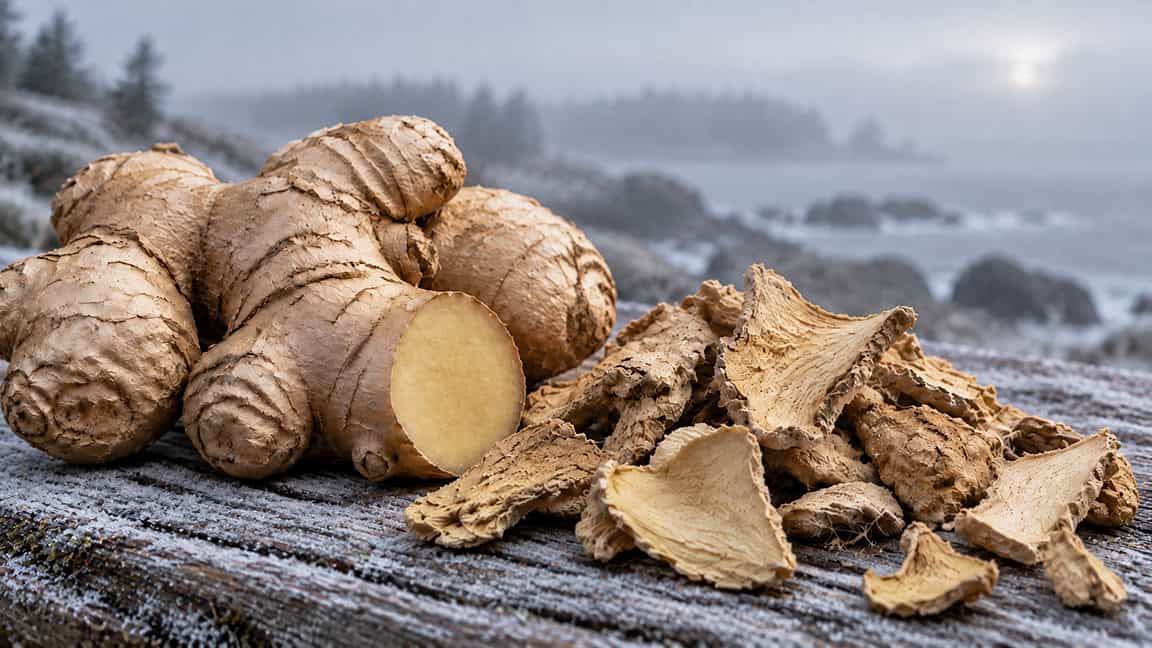
Sheng Jiang is the fresh root, the kind you’d find in the produce section. Spicy, aromatic, and gently warming, it works primarily at the surface of the body. I reach for Sheng Jiang when someone is fighting off the first day of a cold, when nausea has them off their food, or when digestion just needs a nudge rather than a push. It moves outward, encourages the body’s defenses to engage, and settles the stomach.
Gan Jiang is the dried root, not so different, at first glance, from the ground ginger you’d find in the spice aisle and reach for in gingerbread or a spice cake. But the dried ginger used medicinally is a different grade of the same idea: denser, hotter, and slower to act, but longer to hold.
Where Sheng Jiang works at the surface, Gan Jiang reaches deeper. It’s suited to a more entrenched kind of cold, the kind rooted in what Chinese medicine calls deficient yang: hands and feet that never quite warm up, digestion that stays sluggish, fatigue that rest alone doesn’t touch. This herb warms from the interior out, and it’s one I reach for often here in Maine, where a real winter can settle into someone’s constitution and leave them running cold long after the thaw.
The distinction matters. Someone fighting off a chill with the first signs of a cold needs a different preparation than someone who has been running cold and depleted for years. Same root, two preparations, two very different conversations.
What Chinese herbal medicine has always understood
Ginger has been in clinical use for over two thousand years.
The Shang Han Lun, one of the foundational texts of Chinese herbal medicine, leans on fresh ginger constantly. It appears in dozens of the classical formulas Zhang Zhongjing recorded, often paired with jujube to protect the stomach while stronger herbs do their work elsewhere in the formula. This wasn’t incidental. It reflected careful, accumulated observation: that fresh ginger reliably settled the stomach, released the body’s exterior, and warmed digestion without overwhelming it.
That’s a framework that doesn’t translate neatly into Western physiology. But the clinical effects it pointed toward are ones modern research is now examining directly, and the findings are worth knowing about.
What the research shows
The science is catching up with the tradition.
Ginger, mostly studied in its fresh or powdered form, is one of the better-researched herbs for nausea, including a specific and clinically important kind: the nausea that comes with chemotherapy. A 2024 review of 35 clinical trials found that ginger, taken alongside standard anti-nausea medication, meaningfully reduced severe nausea and vomiting in people on strong chemotherapy regimens. A 2019 review synthesizing 18 studies found that ginger taken in small daily amounts for several days cut the likelihood of vomiting by roughly 60% compared with not taking it.
Not every study agrees, and that’s worth saying plainly. An earlier review of nearly 900 patients found ginger didn’t clearly outperform standard anti-nausea medication used on its own. Which is exactly how it tends to be used in practice, alongside conventional treatment, not instead of it.
Underneath the clinical results is a chemical explanation for why fresh and dried ginger behave so differently. Fresh ginger is rich in a compound family called gingerols. As the root dries, or is cooked, those gingerols convert into a related, more concentrated compound called shogaols, which lines up neatly with what practitioners have observed for centuries: dried ginger’s effect runs stronger and reaches deeper than fresh ginger’s.
None of this surprises me. But it’s good confirmation, and it’s a reminder worth sitting with: the root in your crisper drawer is doing more than flavoring your soup.
Why a kitchen spice isn’t the same as a medicine
Context, form, and dose are everything.
You might be wondering if the ground ginger in your baking spices counts. Fair question. It’s the same plant and the same general chemistry, and there’s nothing wrong with the ginger in your gingerbread. But it’s grown, dried, and processed for flavor, not for concentration or consistency of its active compounds, which is a different thing from the herbal-grade Gan Jiang used therapeutically, cultivated and processed specifically to be medicine rather than seasoning. Culinary amounts are genuinely good for you. Therapeutic use is a different conversation, at a different dose, in a different form.
In practice, ginger rarely works alone in a formula. Fresh ginger shows up throughout the classical literature as a supporting herb, softening the harshness of stronger ingredients and protecting the stomach while they do their work. Dried ginger anchors formulas like Li Zhong Wan, built to strengthen digestion in someone running cold from the inside, and Si Ni Tang, used for a more urgent kind of collapse where the body’s warmth needs rescuing fast. In both cases, the ginger isn’t incidental. It’s structural. But what it does depends on what it’s paired with, what pattern it’s addressing, and who’s receiving it.
Western research typically isolates one compound and measures one outcome, and that’s genuinely useful. It’s how we know what we know about gingerol and shogaol. But it’s a different frame than Chinese herbal medicine, where the goal is a formula built for your specific pattern, not a compound matched to a diagnosis.
What this looks like when you come in
Ginger, in one form or another, shows up in a lot of the formulas I write.
I reach for Sheng Jiang most often when someone presents with an oncoming cold, unsettled digestion, or nausea of almost any origin. It’s mild enough to use often and safe enough that I’ll often just recommend it as tea. It’s also just good cold-weather cooking: grated into soups, stews, and winter braises, it’s quietly doing on your stove what it does in a formula, warming you from the inside out. If you’re navigating chemotherapy-related nausea, it’s worth asking your acupuncturist and your oncology team together about where ginger might fit alongside your antiemetics; ginger has a mild blood-thinning effect at higher doses, so it’s a conversation worth having rather than something to add on your own.
Gan Jiang I use more selectively, for patients whose patterns reflect a deeper, more chronic kind of cold, where the warmth needs to reach further and hold longer. It’s a slower, steadier medicine, and it’s not one I’d suggest taking on your own without a practitioner matching it to your actual pattern. I see it a lot up here on the Maine coast: people who run cold all winter, whose hands and feet never quite warm up no matter how many layers they add, or whose energy just doesn’t come back the way it should once the cold weather sets in. That chronic, bone-deep cold is exactly the pattern Gan Jiang was designed for.
In both cases, what I’m tracking isn’t a single symptom. I’m reading a pattern: how you hold warmth, what time of day or year things get worse, what your digestion and your pulse are telling me about your reserves. Ginger, in either form, is one tool in that conversation.
If you’ve been cold all winter and can’t shake it, or you’re navigating nausea from a treatment that’s genuinely hard on your body, that’s worth a real conversation, not a guess at the right tea. Reach out and we’ll figure out which one you actually need.
Running cold, or feeling queasy? Let’s find the right one for you.
Sharon Sherman, MSOM, Dipl. AHM (NCBAHM), L.OM., L.Ac., practiced acupuncture and East Asian Medicine in Philadelphia for over two decades before founding True to Life Wellness in Freeport, Maine in 2025.